
USA Projects
USA Copper Projects Overview
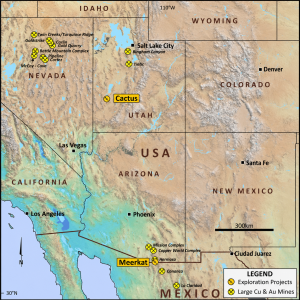
USA project locations: Cactus (Utah) and Meerkat (Arizona) copper projects
Cactus Latest Announcements:
- 4 September 2026 – Hawk Completes Cactus Corridor Drilling Utah, USA
- 11 August 2026 – Hawk Intersects Strong Copper Mineralisation in Comet Zone
- 28 July 2026 – Cactus Copper-Gold Project Drilling Re-commences Utah, USA
- 29 June 2026 – Hawk Intersects More Near Surface Copper in Cactus Corridor
Cactus Copper-Gold Project
Historic Production & District Scale Potential
- Tier 1 mining jurisdictions: Utah and Arizona have world class copper and base metal mines – Bingham Canyon, Mission, Copper World, Hermosa
- Excellent infrastructure: Projects near to road, power, rail and operating copper mines
- Historic production: Cactus Mine delivered 1.3 Mt @ 2.0% Cu, 0.33 g/t Au (1905–1920); Meerkat’s Santo Nino mined grades of 7-8% Cu, 1% Mo (1912-55)
- Geology: Intrusive and breccia-hosted Cu–Au and Cu-Mo systems
- District upside: multiple targets in 1km Cactus Corridor zone plus Meerkat’s Santo Nino magnetic anomaly & Benton district
- Strong copper in current Cactus drilling: 80m @ 0.48% Cu from surface including 19.6m @ 1.25% Cu in hole DD26CT003
Cactus Copper: Strong Copper Grades in Drilling Highlights Potential
Thick Zones of Near Surface Copper in Hawk’s Initial Cactus Corridor Drill Holes
- 80m @ 0.48% Cu from surface includes 6m @ 1.25% Cu (DD26CT003)
- 9m @ 0.36% Cu from 18m depth includes 10.4m @ 0.97% Cu (DD26CT004)
- 7m @ 0.45% Cu from 14m depth includes 4.3m @ 2.2% Cu and 5.8m @ 1.4% Cu (DD26CT005)
- 35-50m estimated true thickness of mineralised zone – thicker than past interpretations
- Molybdenum rich intercepts down holes of 30-46m grading 0.016-0.03% Mo
Results verify historical drill holes and confirm potential for a wide zone of near surface mineralisation in the 1km long Cactus Corridor
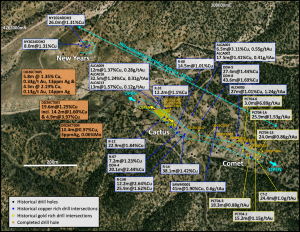
Comet-Cactus-New Years high grade drill intersections
DD26CT003
- Intersected 80m @ 0.48% Cu from surface which includes 5m @ 1.25% Cu from a depth of 44m
- 56% Cu maximum sample assay over 1.52m
- 53m potential true thickness of copper mineralised zone
- Intersected 1m @ 0.03% Mo from 26m below surface
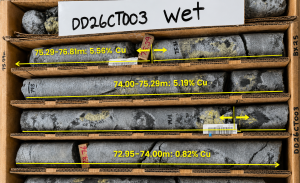
DD26CT003 drill core
DD26CT008
- 18m of visible copper mineralisation from 75m down hole
- Spot pXRF assays grading up to 1% Cu
- Gold potential indicated by highly anomalous Ag, As & Sb
- Hole abandoned in mineralised tourmaline breccia
- Lab assays awaited
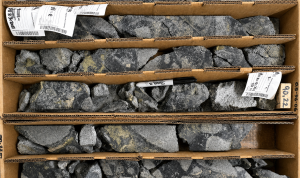
DD26CT008 drill core — spot pXRF assays up to 30.1% Cu
Cactus Copper: Drilling Restarted in July 2026
Cactus Corridor Drilling Recommenced in July 2026
- Primary objective is to delineate copper, gold and silver mineralisation within 50m of surface along the corridor
- Ten 50m spaced drill holes planned over 550m between the historical Cactus and Comet mines
- Spot pXRF assays up to 66% Cu (DD26CT010) with visible copper mineralisation intersected in 5 of 7 holes to date
Results to indicate potential for open pittable mineralisation in the Cactus Corridor
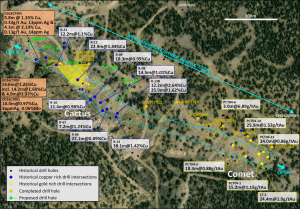
Cactus Corridor drill hole plan
Meerkat Latest Announcements:
Meerkat Copper: Porphyry Target in World Class Porphyry Belt
- Located in world class copper belt: Hosts major copper and base metal deposits – Mission, Copper World and Hermosa in southern Arizona plus Cananea, Milpillas and La Caridad in northern Mexico
- High grade historic production: Santo Nino deposit in northwest mined grades of 7.0-8.0% Cu, 1% Mo (1912–1955)
- Geology: Lies within the highly mineralised Laramide Magmatic Arc which extends from northern Mexico through the USA to Canada
- District upside: Classic porphyry-type magnetic anomaly from recent drone survey in northwest plus geochemical targets around the historical Benton & Line Boy mines in southeast
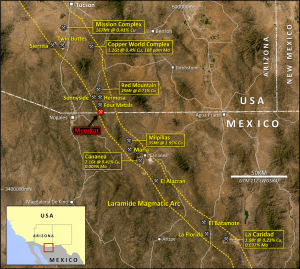
Meerkat project location within the regional porphyry copper belt
Meerkat Copper: ‘Classic’ Porphyry Type Magnetic Anomaly
- In the northwest: A ‘classic’ 1km diameter porphyry copper type magnetic anomaly
- Historic Santo Nino Cu-Mo mine (1912-55) which mined 7-8% copper & 1% molybdenum grades from a ‘felsic dyke’
- No post-mining exploration records for Santo Nino
- In the southeast, past exploration focused on copper mineralised breccia bodies near the historical Benton and Line Boy mines
- Shallow historical drill intersections include:
- 9m @ 0.35% Cu Eq from 71.3m down hole (R-30)
- 0m @ 0.47% Cu Eq from 26.1m down hole (R-33)
- 2m @ 0.91% Cu Eq from 127.9m down hole (R-33)
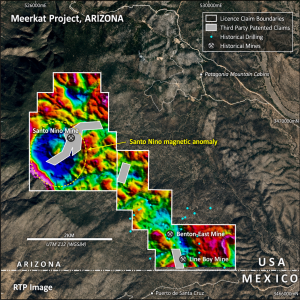
Meerkat magnetic anomaly map (RTP image)
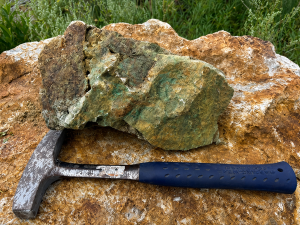
Copper in intrusive at Cell Tower


